
Managing inventory is one of the biggest challenges in the jewellery industry. Every item has a different weight, purity, stone combination, making charge, and value. Unlike most retail businesses, jewellery inventory changes constantly because of fluctuating gold prices, repairs, manufacturing, exchanges, and customer orders.
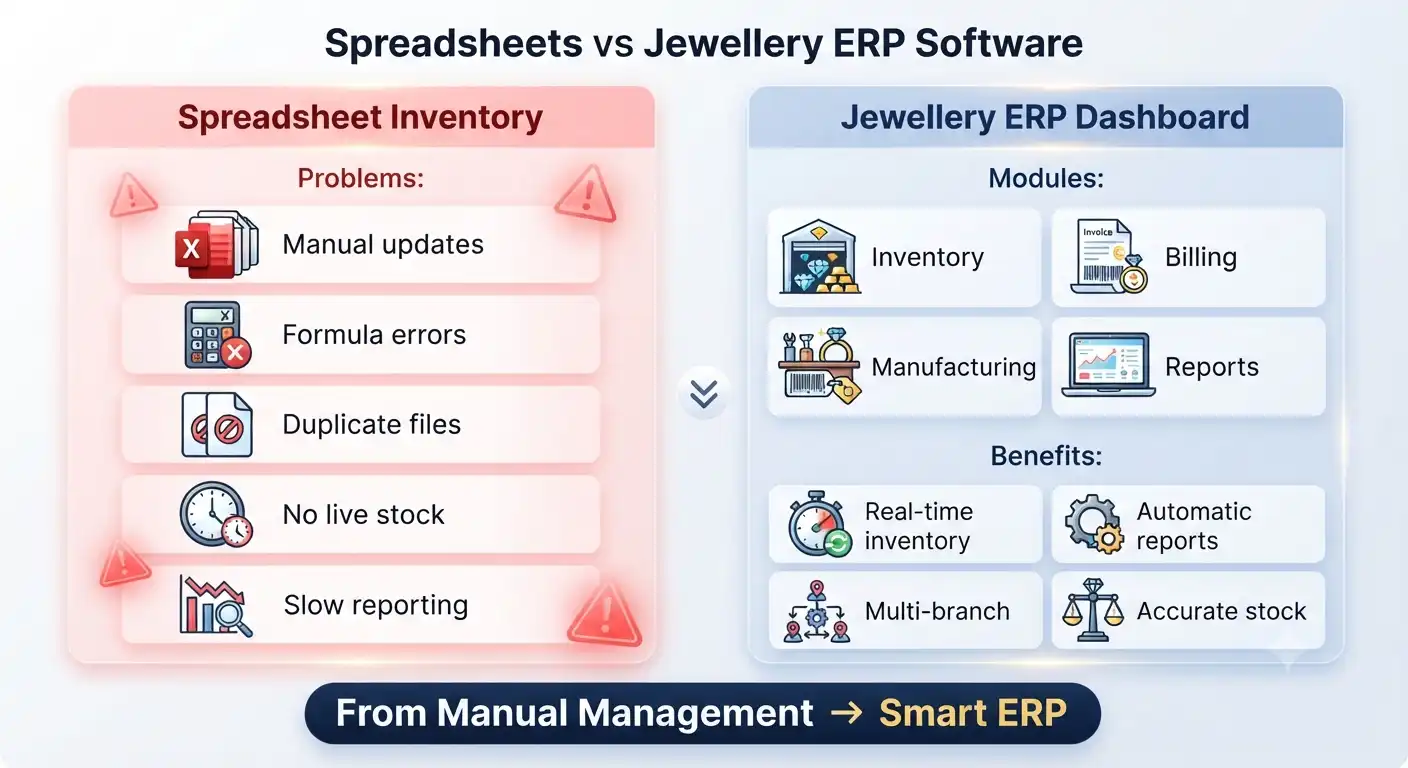
Many jewellery businesses begin by managing inventory in Excel or Google Sheets. While spreadsheets are inexpensive and familiar, they become difficult to manage as inventory grows. Manual updates, duplicate files, and missing records often lead to stock mismatches, reporting delays, and costly mistakes.
In this guide, we’ll explain why spreadsheets are no longer suitable for modern jewellery inventory management and how jewellery ERP software helps businesses improve accuracy, efficiency, and control.
Why Jewellery Inventory Management Is More Complex Than Other Industries
A jewellery business does not simply track product quantities. Each piece has multiple attributes that affect its value and inventory record, including:
- Gold weight
- Stone weight
- Gold purity (18K, 22K, 24K)
- Making charges
- Wastage
- Hallmark and HUID details
- Design number or SKU
- Serial number or barcode
- Manufacturing status
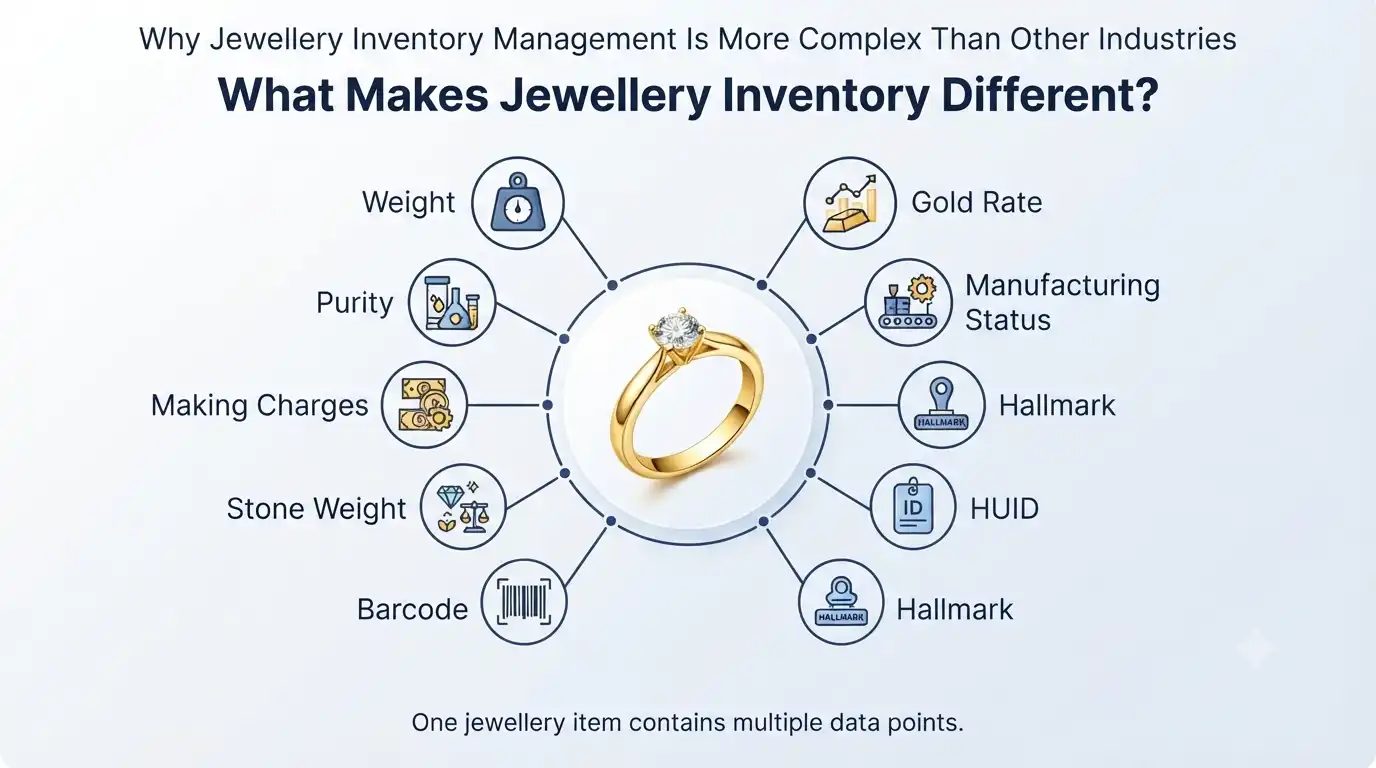
These details can change throughout the product lifecycle. Jewellery may be resized, repaired, polished, exchanged, or modified with additional stones. Gold prices also fluctuate daily, affecting inventory valuation and profitability. Generic spreadsheets are not designed to manage this level of complexity.
The Biggest Problems with Using Spreadsheets for Jewellery Inventory

Manual Data Entry Leads to Costly Errors
Every spreadsheet depends on manual data entry.
Entering an incorrect weight, purity, or making charge can affect inventory value, pricing, and financial reports. Formula errors, accidental deletions, and duplicate records become more common as the inventory grows.
For example, recording a gold necklace as 18.60 g instead of 16.80 g immediately changes its inventory value and can lead to incorrect billing and purchasing decisions.
Because jewellery items are high-value assets, even small mistakes can result in significant financial losses.
No Real-Time Inventory Visibility
Spreadsheets cannot provide live inventory updates. A typical situation looks like this:
- One employee updates the spreadsheet.
- Another employee opens an older version.
- Someone forgets to save their changes.
- Multiple versions of the same file exist.
As a result, staff cannot always confirm whether a jewellery item is available for sale. This delays customer service, creates confusion between departments, and reduces confidence in inventory records.
Difficult to Track Individual Jewellery Pieces
Unlike standard retail products, many jewellery items must be tracked individually rather than by quantity. Each piece may have:
- A unique barcode
- RFID tag
- Serial number
- Hallmark or HUID
- Diamond certificate
- Custom design specifications
Managing thousands of unique jewellery pieces inside spreadsheets quickly becomes unmanageable. Modern jewellery ERP systems provide piece-level inventory tracking, making every item fully traceable from manufacturing to sale.
Poor Stock Control Across Multiple Locations
As jewellery businesses expand, inventory moves between:
- Showrooms
- Manufacturing units
- Warehouses
- Branch stores
- Exhibitions
Tracking these transfers manually often creates discrepancies. Without a central inventory management system, businesses may experience:
- Missing stock
- Duplicate records
- Incorrect stock balances
- Delayed stock reconciliation
A jewellery ERP maintains a single, central database where inventory updates automatically across every location.
Limited Security and Accountability
Anyone with spreadsheet access can modify data. In many cases, businesses cannot determine:
- Who changed the record
- When the change occurred
- Why the inventory was updated
When inventory discrepancies appear, managers spend hours investigating instead of solving the problem. Jewellery ERP software records every action with complete audit trails, improving accountability and reducing operational risk.
Reporting Takes Too Much Time
Business decisions depend on accurate reports. With spreadsheets, generating reports often requires manual filtering, formulas, and data validation. Important reports include:
- Stock ageing
- Fast-moving products
- Slow-moving inventory
- Gold exposure
- Inventory valuation
- Profit margins
- Purchase history
- Sales performance
By the time manual reports are completed, the information may already be outdated. ERP software generates these reports automatically using real-time business data.
Compliance Becomes More Difficult
Indian jewellers must increasingly manage compliance requirements such as BIS hallmarking and HUID tracking alongside GST documentation. Managing these records manually increases the likelihood of errors and missing information. Jewellery ERP software helps organise these records digitally, making audits and compliance much easier.
How Jewellery ERP Software Solves These Challenges
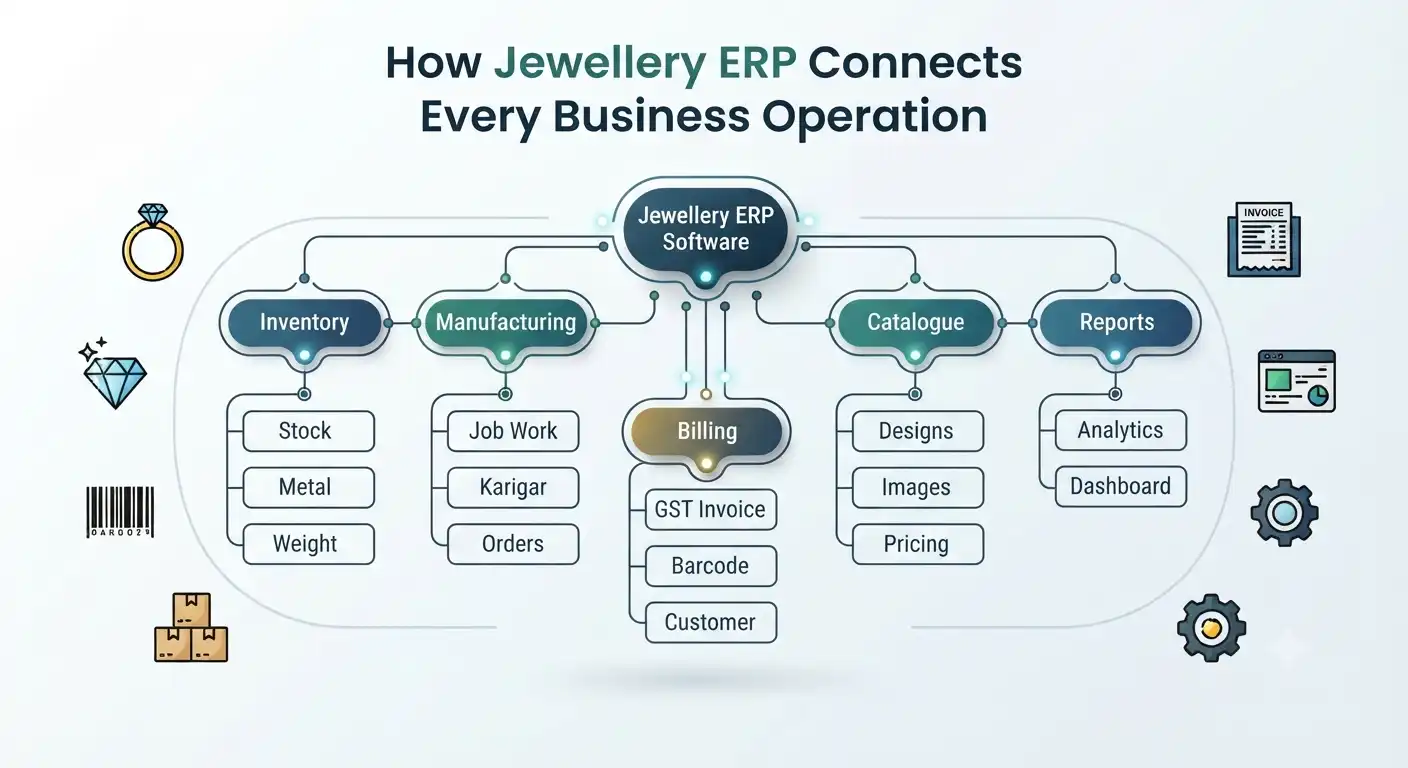
A jewellery ERP system is designed specifically for jewellery manufacturers, wholesalers, and retailers. Instead of simply storing inventory data, it automates business processes and keeps every department connected.
Real-Time Jewellery Inventory Management
Every inventory movement updates immediately. Whether an item is:
- Purchased
- Manufactured
- Sold
- Returned
- Repaired
- Transferred
the inventory record changes instantly. Employees always work with accurate, up-to-date information.
Piece-Level Inventory Tracking
Each jewellery item has its own digital record containing:
- Product image
- Gold purity
- Weight
- Stone details
- Barcode or RFID tag
- Hallmark or HUID
- Manufacturing status
- Sales history
This provides complete traceability throughout the product lifecycle.
Automatic Gold Rate Integration
Because gold prices change frequently, manual inventory valuation becomes difficult. Many jewellery ERP systems support gold rate updates, allowing inventory values, quotations, and pricing calculations to remain accurate with minimal manual effort.
Barcode and RFID Inventory Tracking
Modern jewellery businesses increasingly use barcode and RFID technology for inventory management. Benefits include:
- Faster stock audits
- Reduced manual counting
- Improved inventory accuracy
- Better loss prevention
- Faster stock verification
RFID can significantly reduce the time required for inventory audits compared with manual counting, particularly in larger jewellery businesses.
Better Audit Trails
Every inventory transaction is recorded automatically. Managers can instantly identify:
- Who updated inventory
- When changes occurred
- What information changed
This improves transparency and reduces internal errors.
Powerful Reporting and Analytics
Jewellery ERP software provides instant reports such as:
- Inventory ageing
- Stock valuation
- Gold exposure
- Sales trends
- Manufacturing progress
- Purchase analysis
- Branch performance
- Profitability reports
Instead of spending hours building spreadsheets, businesses can make faster, data-driven decisions.
Supports Business Growth
As the business grows, ERP grows with it. Whether you operate:
- One showroom
- Multiple retail branches
- Manufacturing units
- Wholesale operations
- Franchise locations
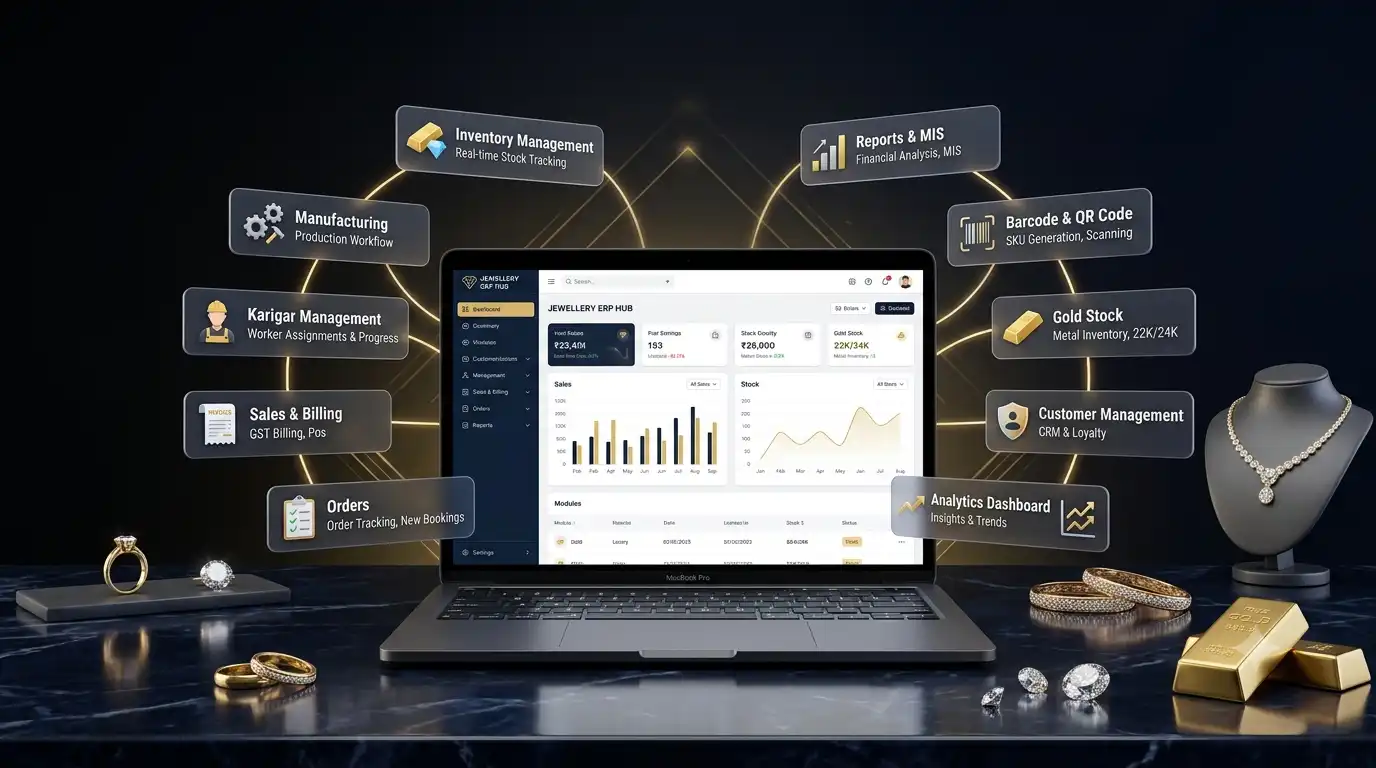
the system keeps inventory, sales, purchasing, accounting, and production connected in one platform.
What to Look for in Jewellery ERP Software
Not every ERP is built for the jewellery industry. When evaluating software, look for features such as:
- Jewellery inventory management
- Weight-based stock calculations
- Purity and karat tracking
- Barcode and RFID support
- Hallmark and HUID management
- Manufacturing and karigar management
- Repair management
- Purchase and vendor management
- Multi-branch inventory
- Real-time reporting
- GST billing integration
- Role-based access control
- Audit logs
Industry-specific solutions such as Joolet Jewellery ERP are designed to handle the operational needs of jewellers more effectively than generic ERP or accounting software.
Are Spreadsheets Ever Useful?
Yes.
Spreadsheets are still useful for:
- Quick calculations
- Temporary analysis
- Simple budgeting
- Small one-time reports
However, they are not designed to manage high-value jewellery inventory, multiple branches, manufacturing workflows, or compliance requirements. As inventory increases, spreadsheets become harder to maintain and more prone to costly mistakes.
Final Thoughts
Spreadsheets may work when a jewellery business is small, but they become increasingly difficult to manage as inventory, staff, and operations grow.
A dedicated jewellery ERP system provides:
- Real-time inventory visibility
- Accurate stock tracking
- Piece-level traceability
- Automated reporting
- Better audit control
- Improved compliance
- Faster business decisions
For jewellery businesses looking to improve inventory accuracy, reduce manual work, and support long-term growth, moving from spreadsheets to a jewellery ERP is a practical investment rather than simply a software upgrade.