
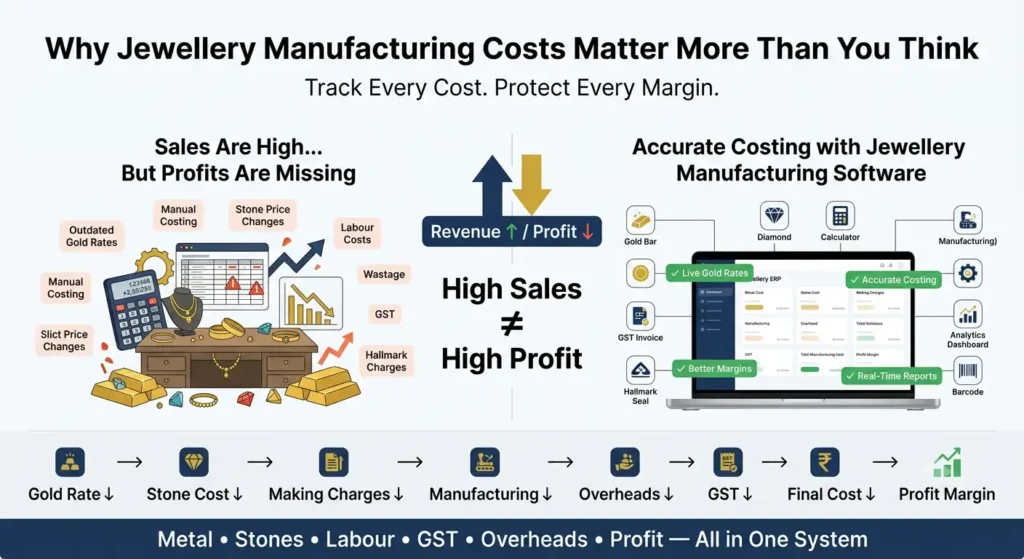
“You can do ₹2 crore in sales in a season and still wonder where the money went.”
It happens more often than you think. The shop is busy, orders are moving, and karigars are working. Yet the margin is missing. In most cases, it is not a sales problem. It is a costing problem that quietly drains the business over time.
At Joolet, we see this regularly while working with manufacturers, retailers, and wholesalers across India. Let’s break down what affects jewellery manufacturing costs and where most businesses go wrong.
Metal Cost — Why Using Outdated Rates Hurts Your Margin
Gold is not a fixed cost. It changes daily on MCX, sometimes even hourly.
Many businesses still calculate using weekly averages or outdated rates. In a volatile week, the difference can be ₹80 to ₹150 per gram. On a 20-gram piece, that becomes ₹1,600 to ₹3,000 per piece.
That is not a small error. It is a serious loss.
Metal costing basics
- 22k is standard for traditional jewellery, 18k for diamond and fashion pieces
- Always use today’s MCX rate
- Weight is measured in grams or tola (1 tola = 11.66 grams)
- Include 8 to 15 percent metal wastage
Stone Costs — Small Items, Big Impact
If you use polki, diamonds, kundan, or other stones, confirm the cost before quoting.
Stone prices change frequently. Even a small variation per carat adds up quickly, especially in bridal jewellery.
Key factors
- Type of stone
- Quality variation in polki
- Additional materials like lac, gold foil, and enamel
- Labour required for setting
Maintain a regularly updated stone cost sheet instead of relying on memory.
Making Charges — Often Outdated and Underpriced
When did you last calculate your actual making cost?
Many jewellers set a rate once and never revisit it. Meanwhile, labour, electricity, and material costs increase.
Making charges should include
- Karigar wages
- Stone setting labour
- Finishing and polishing
- Specialised work like meenakari or jadau
- Workshop overhead and profit margin
Typical benchmarks
- Simple designs: ₹200 to ₹400 per gram
- Medium complexity: ₹400 to ₹700 per gram
- Intricate designs: ₹800 to ₹1,500+ per gram
Casting and Finishing Costs
If outsourced, casting costs depend on weight and complexity.
If done in-house, include:
- Investment materials
- Gas and electricity
- Equipment wear
- Rhodium plating
Finishing is often underestimated. Polishing, cleaning, and inspection all add real cost.
Findings and Components
Small items like clasps, hooks, and solder seem minor but add up quickly.
Ignoring these can lead to monthly losses of ₹8,000 to ₹15,000.
Create a component cost list and update it regularly.
BIS Hallmarking Costs
Hallmarking is mandatory and must be included in costing.
- Typical cost: ₹35 to ₹45 per piece
For large volumes, this becomes a significant monthly expense.
GST Impact on Pricing
- Gold jewellery: 3% GST
- Making charges billed separately: 5% GST
- Cut and polished diamonds: 1.5% GST
- Polki: 0.25% GST
GST is not profit, but incorrect handling affects your margin.
Overhead Costs
Include all indirect expenses:
- Rent
- Electricity
- Staff
- Packaging
- Software
- Insurance
Jewellery Manufacturing Cost Calculation Example
| Cost Item | Details | Amount (₹) |
|---|---|---|
| Metal | 20g × ₹6,200/g (today’s 22k rate) | ₹1,24,000 |
| Stones | Mixed polki, 3 carats | ₹18,000 |
| Making Charges | 20g × ₹600/g | ₹12,000 |
| Findings and Components | Hooks, lac, gold foil | ₹400 |
| BIS Hallmarking | 1 piece | ₹45 |
| Overhead Allocation | Monthly cost distribution | ₹1,200 |
| Total Cost Before GST | ₹1,55,645 | |
| GST (3%) | On total value | ₹4,669 |
| Total Cost to Customer (Before Margin) | ₹1,60,314 |
Your final selling price = total cost + your profit margin. Always calculate using actual numbers, not estimates.
What Margin Are You Working With?
- Manufacturer to retailer: 8 to 15%
- Retail margin usually comes from making charges
- Custom and bridal jewellery allows higher margins
- Gold exchange rates also affect profitability
Bridal and Custom Orders
The bridal season drives major revenue, but poor costing can reduce profits. Multiple design revisions increase labour time and cost.
Best practices
- Take advance payment before starting design
- Limit revisions clearly in your quote
- Charge separately for design work
- Track actual cost versus estimated cost per order
The Real Problem Is Not Knowledge, It Is Systems
Most jewellers already understand costing basics. The issue is consistency. Without a proper system, tracking becomes manual and errors increase. Jewellery manufacturing software helps automate costing, track every component, and maintain accurate margins without daily manual work.