
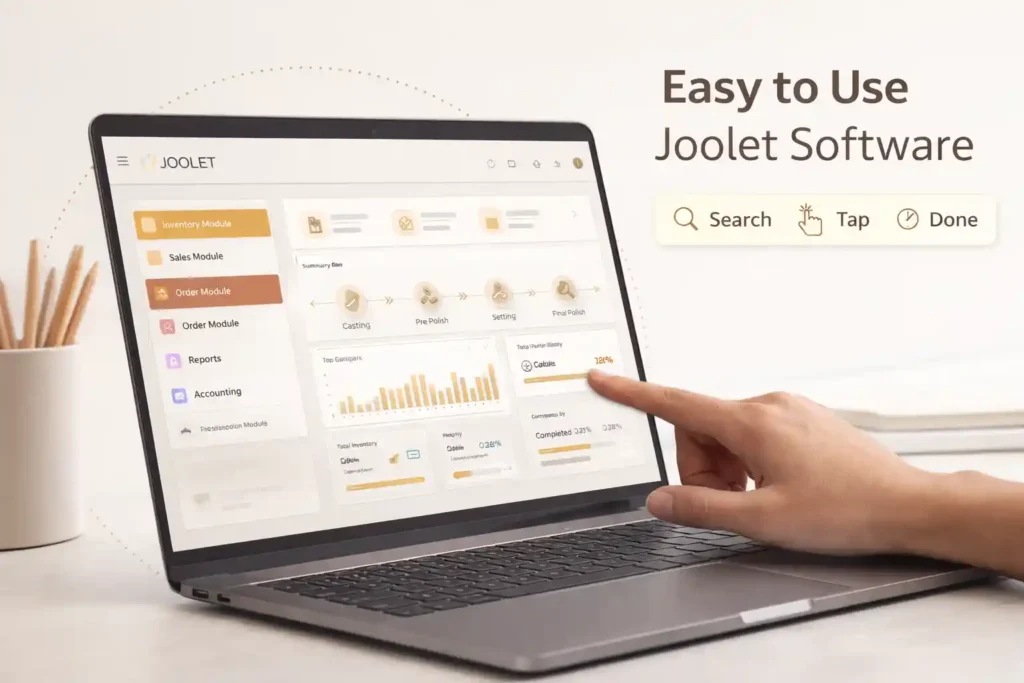
Running a jewellery business isn’t simple. Most owners deal with the same daily problems. Tracking gold, managing designs, handling stock, controlling metal loss, and keeping records accurate.
Many still rely on spreadsheets. At first, they seem easy and cost-effective. But as the business grows, problems start to appear quickly.
Let’s break down why spreadsheets fail in jewellery inventory management and how ERP solves these issues. Check the full guide to what is Jewellery ERP software.
Jewellery inventory is not simple
Jewellery is very different from selling standard products like shoes or electronics.
A single item can involve:
- Gold weight
- Stone weight
- Purity
- Making charges
- Wastage
These values do not stay fixed. Repairs, resizing, or stone changes can alter both weight and value. On top of that, gold rates change daily.
Spreadsheets are static. Jewellery inventory is not.
Errors happen faster than you think
Spreadsheets rely completely on manual entry.
One wrong number. One misplaced formula. One outdated file.
That is all it takes.
These errors often go unnoticed until stock does not match. Then you spend hours checking rows and formulas. Sometimes you still cannot find the real issue.
And in jewellery, even small mistakes can cost real money.
No real-time stock visibility
Spreadsheets do not show live data.
- One person updates the file
- Another opens an older version
- Someone forgets to save
Now you have multiple versions of the truth.
So when a customer asks if an item is available, you hesitate. You check. You delay.
That slows down sales and makes your business look unprofessional.
Tracking each piece becomes messy
Jewellery businesses often need piece-level tracking, especially for high-value items.
Spreadsheets struggle here:
- Too many rows
- Complex filters
- Easy to break sorting
One small mistake can scramble your entire dataset.
Once it gets messy, fixing it takes more time than it is worth.
No control or accountability
Anyone with access can edit a spreadsheet.
You usually cannot track:
- Who made a change
- When it was made
- Why it was made
So when there is a mismatch, you are left guessing.
Was it a sale, repair, transfer, or something else?
That is not a system. That is a risk.
Reporting is slow and unreliable
Want to know:
- Slow-moving stock
- High-value items
- Aging inventory
- Gold exposure
In spreadsheets, this means building reports manually every time.
By the time you finish, the data may already be outdated.
That leads to delayed decisions or decisions based on guesswork.
How ERP solves these problems
An ERP system is built for complex inventory like jewellery. It does not just store data. It manages it.
One source of truth
All departments work on a single system:
- Sales
- Inventory
- Accounts
- Workshop
Every update reflects instantly across the system.
No duplicates. No confusion.
Real-time inventory
You can view stock live:
- By store
- By design
- By purity
- By weight
So when a customer asks, you have an immediate answer.
This builds trust and speeds up sales.
Piece-level tracking
Each item is tracked individually with full details:
- Gold weight
- Stone details
- Cost
- Status
If a ring goes for repair or its weight changes, the system records everything, including history.
This is critical for audits and dispute handling.
Built-in control and audit trail
Every action is logged.
You can see:
- Who made changes
- What was changed
- When it happened
This reduces misuse and improves accountability.
Fast and accurate reporting
Reports are generated instantly:
- Stock aging
- Inventory movement
- Margins
- Gold exposure
No manual work. No delays.
Just clear, reliable data for better decisions.
Scales with your business
As your business grows:
- More stores
- More staff
- More inventory
ERP keeps everything connected and consistent.
Growth becomes manageable, not chaotic.
Choosing the right jewellery ERP
Not all ERP systems are built for jewellery.
You need features like:
- Weight-based calculations
- Purity tracking
- Repair management
- Detailed audit logs
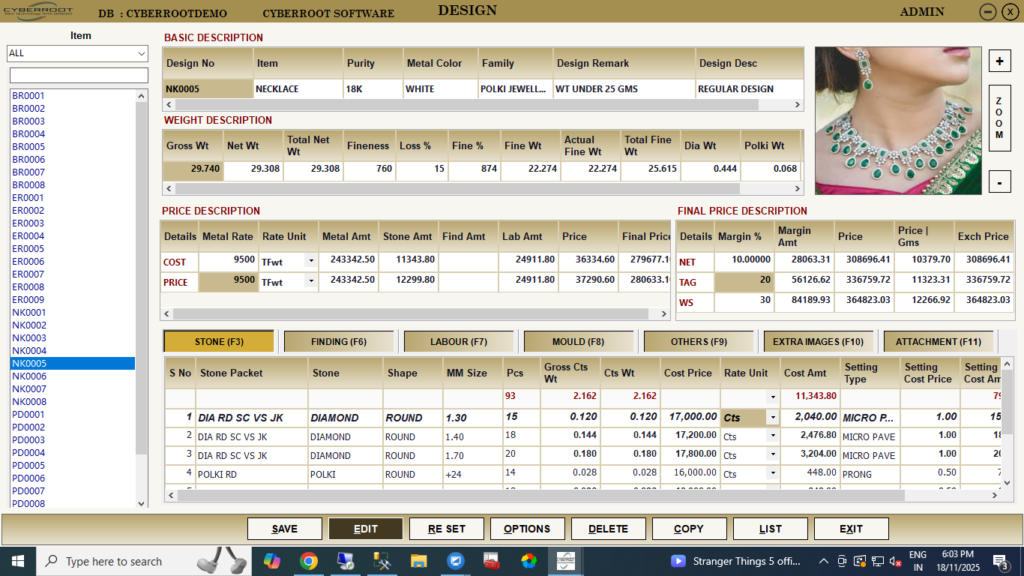
Jewellery-focused solutions like Joolet Jewellery ERP are made for how jewellers work. They do not force generic systems into a complex business.
Do spreadsheets still have a place?
Yes, but only for small tasks.
Spreadsheets are useful for:
- Quick calculations
- One-time analysis
But they are not built to manage full jewellery inventory.
That requires structure, control, and accuracy.
Final thought
Jewellery inventory is valuable and sensitive.
Managing it in spreadsheets is like storing gold in an unlocked drawer. It might work for a while. Then it fails.
ERP does not remove every problem. But it removes the biggest ones:
- Manual errors
- Lack of visibility
- Data confusion
If inventory issues keep repeating, the problem is not your team.
It is your system.